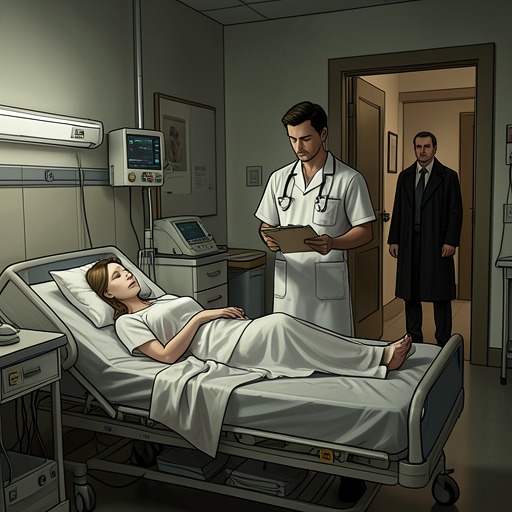
Eldon Mate–Joanne Doss physician–patient relationship
Dr. DeathEldon Mate’s physician–patient relationship with Joanne Doss culminates in his helping her end her life, but the novel gives no direct account of their consultations or the procedure itself. Instead, the relationship emerges through the aftermath: Joanne’s drawn-out decline, the unsuccessful search for a diagnosis, and the competing explanations offered by her husband, daughter, and the clinician investigating Mate. That distance matters. The reader encounters a consequential medical act through testimony and interpretation, with Joanne’s own wishes known only indirectly.
Medical Context and an Unexplained Decline
Richard Doss describes an illness that began with fatigue in a woman he remembered as energetic and athletic. Joint pain, headaches, skin sensitivity, and increasing exhaustion followed. He says the family consulted dozens of doctors and that Joanne underwent extensive testing, including CAT scans, MRIs, blood tests, and two lumbar punctures. In his account, one neurologist performed the punctures without a clear reason, still searching for an explanation.
The available medical record reinforces the uncertainty without resolving it. Fifteen other doctors appear in the records Alex Delaware reviews, alongside lab reports, imaging, and physician notes; the results he encounters are characterized as negative. The repeated tests establish how much medical attention Joanne received, but they do not identify a cause for her suffering. The case therefore resists a simple division between a diagnosed physical illness and a purely psychological explanation: the investigation records symptoms and extensive clinical work while leaving the underlying condition unsettled.
Richard’s account also traces a marked withdrawal from ordinary life. Joanne stopped entertaining and socializing, gave up tennis, golf, and exercise, and began spending most of her time in bed. She continued eating, eventually gaining a reported hundred pounds in less than a year, while becoming harder for Richard to reach emotionally. He recalls that she disengaged from him, their children, and the role of motherhood. His account makes that withdrawal central to his understanding of what happened, but it is also filtered through his distress and judgment about the transformation of his wife.
A washed-out Polaroid gives that change a stark visual form: Joanne lies amid pillows on a king-size bed, her face so swollen that her features seem compressed. The photograph documents her altered appearance, not the cause of it. Placed alongside Richard’s recollections and the inconclusive test results, it makes visible the bodily decline that neither family interpretation nor medical investigation fully explains.
Mate’s Role and Joanne’s Decision
The family learns that Mate helped Joanne die, but the account supplies no detailed description of how the two came to their arrangement. Stacy says she had no warning from her mother and that Joanne never told her goodbye. On the morning before she died, Joanne called Stacy in to say hello before school and told her she looked pretty; Stacy recalls nothing unusual in the exchange. The ordinary tenderness of that memory sits against the finality of the decision Stacy learned about afterward.
Stacy eventually understands the death as consistent with what she saw as her mother’s extreme passivity and self-erasure. She argues that Mate was the vehicle rather than the source of Joanne’s wish: her mother, in Stacy’s view, could have chosen someone else, and had already withdrawn from life before Mate became involved. This is Stacy’s attempt to make sense of a decision that left her without a farewell, not a clinical finding about Joanne’s capacity or state of mind. Her distinction nevertheless challenges the public framing that casts Mate as the sole actor and Joanne as merely acted upon.
The practical and emotional distance between the patient and her physician remains part of the relationship’s significance. The text establishes that Mate assisted Joanne’s death, while leaving the private conversations, the terms of her request, and the precise circumstances of his involvement outside the scenes shown. Joanne’s decision is therefore both the event that defines the relationship and a fact the reader can approach only through what others say afterward.
Family Accounts and Conflict
Richard also interprets Joanne’s decline as psychological. He says she had chosen to withdraw from life, calls Mate a quack, and believes that psychiatric treatment and commitment might have prevented her death. His certainty contrasts with the inconclusive medical records: he offers a forceful explanation and a counterfactual path to survival, but neither establishes what caused Joanne’s symptoms or what she herself wanted at the end.
That conflict is intensified by Richard’s open hatred of Mate. His hostility shapes how he describes the physician’s role, while Stacy rejects the idea that blaming Mate settles the question of agency. The children’s and father’s different responses expose a family unable to agree on what Joanne’s death means: to Richard, Mate completed a destructive process; to Stacy, her mother had made the decision and Mate enabled it. Neither account restores the conversation or goodbye the family did not have.
Ethical Significance
Alex Delaware’s reflections place Mate’s actions beside the quiet, sometimes undocumented decisions made in hospitals to ease the suffering of dying children. Alex recalls serving on a hospital committee charged with developing guidelines for ending treatment in terminal illness, even as physicians and nurses sometimes gave slightly larger doses of morphine to children who were unlikely to survive. The comparison turns on motive and manner: Alex can understand those acts as compassionate, yet suspects Mate’s intentions and is troubled by his apparent self-satisfaction and publicity-seeking. The contrast does not prove what Mate intended with Joanne; it reveals the ethical unease through which Alex evaluates him.
The relationship thus concentrates the novel’s argument about care and control without resolving it into a single verdict. Joanne’s medical decline is documented but unexplained; her apparent choice is reported by family members rather than narrated by Joanne herself; and Mate’s assistance is known principally through its consequences. The gap between bodily evidence, family interpretation, and the absent patient’s voice keeps the question of responsibility open. Mate’s role cannot be separated from Joanne’s agency, but neither can the claim of agency erase the ethical weight of a physician’s participation in her death.